Open Source Network and February 6
On February 6, 2023, a devastating event occurred in the geography we share. As a result of the earthquake disaster that occurred in Kahramanmaraş and affected at least 10 more provinces, the people who shared the same geography experienced losses and trauma.
We wanted to accomplish what first came to mind for people who had never received any search-and-rescue training, would be stopped on the road if they wanted to go to the region, were unorganized, and could volunteer to do something: to help those affected by the disaster through the subjects we are professional in.
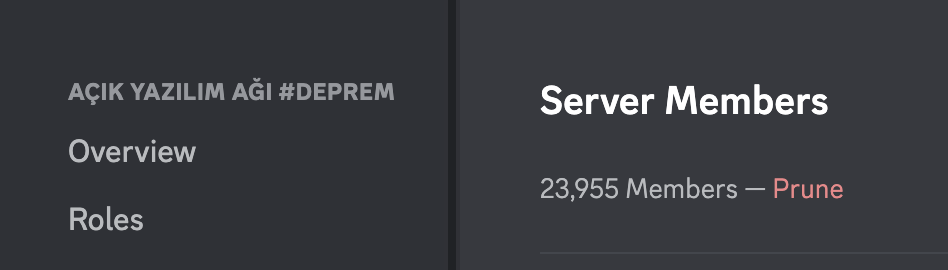
On the occasion of this painful event, when I last checked, we gathered in a Discord server with volunteers whose population exceeded 23,950 people, working in the field of software, and began to call ourselves the Open Source Network.
Note: Since February 6, I have written briefly all the time to use time effectively, trying not to consume anyone's time excessively. You may have observed on Discord that I spoke the least on stage, and on Twitter I tweeted quite rarely. The reason I am writing this long article today is to answer the messages people have sent me privately about what comes next, collectively rather than one by one. And if there are still issues we haven't communicated about and question marks, I am publishing this article to answer them openly.
How did we come together?
I both made many broadcasts on behalf of the community before and saw my colleague Furkan Kılıç's messages on Twitter with İrem Kömürcü, whom I knew from the software ecosystem, discussing how they could help. I personally hadn't been able to follow any news yet, and I was preparing for my company's planning meeting. During our meeting, I was reading messages on Twitter out of the corner of my eye and trying to follow the Telegram group that was opened for Furkan's idea of "let's create a heat map."
As soon as our meeting ended, we moved to Discord. Furkan and I did a small planning where "I would handle general authorization, and they would start implementing."
Furkan's "idea of creating a heat map of rescue calls produced by people on social media" was based on such a fundamental truth that... on a macro scale, no one outside the authorities in the country could get news from the region, and on a micro scale, with the liveliness of the event, people who couldn't understand what was happening in their own neighborhoods could observe what intensity was in which region. This simple but powerful idea spread in waves with the call "come let's develop it together." People began to gather in the Discord server we created with the name "IT Disaster Relief."
How did we grow?
When our open call to everyone in contact with the IT sector found a response, Furkan and my initial strategy was for him to work on the project, for me to look at the bigger picture and handle authorizations, and for me to open repositories.
What I would do on my own behalf was already clear in my mind, github.com/acikkaynak had been there since 2015 and was already ready to develop together with people. The conceptual infrastructure adopted in small projects conducted in my own circle and with friends I knew from the community was conducive to a ground where many professionals could also be involved in these works.
Furkan, on the other hand, created teams like frontend, backend, and design, and directed some of these people to me to be authorized in projects.
From that point on, we structured our projects to be examined by everyone with the Apache 2.0 open source license, developed under everyone's supervision. We were transparent on every issue except data, and we established a principle to share data only with NGOs/authorized institutions/accredited institutions. These formed the two basic principles we protected carefully throughout the process.
When I last checked, we were just under 24,000 people on just our Discord server. During the process, there were certainly people we offended, who felt they couldn't participate and moved away.
What does being open source mean?
We adopted the criterion that projects should be open source because our goal from the beginning was: the work we do should be auditable, if necessary, integrable into specific systems, and open to development in a way that other people could also take hold of with minimal effort.
If someone involved in a project at a corporate company could start developing "in accordance with processes" perhaps by the end of the 3rd week, this period was reduced to 5-6 minutes for us.
A point we couldn't think about at that moment with the motivation of "getting the project out" but later realized is; by proceeding open source from day 1, we actually enabled any NGO/authorized institution/accredited institution in any country to use these systems independently of us.
Because it was developed as open source, we no longer have the chance to "close" the source code of these projects or prevent them from being used elsewhere. In this sense, the source code of the project is not in anyone's ownership or monopoly. Unfortunately, as volunteers, we ended up donating these works to the world's knowledge treasury.
What types of projects are being developed?
First, we came out with afetharita.com. Then, as new ideas came, we again evaluated projects coming from an open source software foundation perspective (Apache Foundation, CloudNative Computing Foundation, Free Software Foundation, Linux Foundation, Mozilla Foundation, etc.), created volunteer teams for them, and tried to remove obstacles in their progress.
Today you can view the projects we are working on under the Our Projects section.
Where are audit and security at?
When it comes to open source development, let's address one of the first questions that comes to mind: No, not everyone can interfere as they wish. First, project leaders are authorized in projects. However, everyone can read the code being developed and make new change suggestions. You can think of this as a parliament structure. Just as laws are open to everyone and not every law proposal is accepted, this process also proceeds with "proposals." Those authorized in the project can also accept these proposals, think about them, and decide whether or not to include them in the project.
During the process, we also formed an infrastructure team that worked voluntarily day and night, and they, along with cloud providers who did not hold back their support during the process, provide a reliable environment.
Especially with cyber attacks coming on the 2nd day after the disaster, with the support of very experienced cyber security firms and experts from the sector, we reached a structure where we had our vulnerabilities checked both on the code side and the infrastructure side at regular intervals.
Who supported us?
Almost everyone!
Volunteers on day 0.
Hours later, all major cloud service providers tried to help us. Not only was there no refusal to any of our service requests, but they removed limits in their existing services for us.
With people in project teams informing their companies, companies also reached out to us and asked "how they could help." Many companies supported their employees to contribute as open source. We brainstormed on how to support in relevant areas and they were always open to communication.
What were our sectoral gains?
It is clear that coming together with this disaster situation caused much loss to our country and geography. Excluding the parts of the work that provide back services to field NGOs/authorized institutions/accredited institutions (otherwise it could mean we exceed our limits and compete with other institutions, so please forgive us) Keeping all these losses in mind and heart, if we need to make only a technical evaluation within the scope of work here:
-
People in the IT sector left behind heated discussions and resentments on Twitter, came together on the ground of mutual aid and solidarity in difficult times, and felt they could work together
-
Hundreds of people discussing how to get help to the field until the early morning refreshed all of our belief in each other
-
People became acquainted with new working disciplines such as open source development, cloud services, etc.
-
We were able to put in order in 2-3 days what many organizations would take years to achieve through certain sector practices
-
We were able to create software that worked in what seemed like chaos, that was live
-
We proved to institutions that "open source development," which they had approached with reservations many times in the past for "legal" reasons, was not something to worry about
-
People under different institutions worked with each other, different approaches, different cultures came together and got to know each other and started new relationships
-
We looked like people who constantly argued about software, and both ourselves and external parties were able to observe our potential
-
We created inspiration "influence" to institutions, media, our surroundings, future generations, and most of all to ourselves. In a meeting with a friend, they told me they had been going through bad times in software for 1-2 months but were reborn with the unity here.
Moreover, we received messages like this: "My relative in Hatay who became an orphan at age 12 told me brother, let's add a section for children, buy me a computer, I'll write code, asking me get me afetcocuk.com."
What comes next?
There is an answer to this both personally and for the Open Source Network.
During planning, I was careful to stick to certain principles, and I was happy to see that other friends of ours on the coordination side agreed:
-
To prevent repetition in our work and to focus,
-
To remove unnecessary burdens from the backs of volunteering people as much as possible,
-
To stay on legal ground,
-
Not to create bad feelings in people contributing voluntarily,
-
To carry as much load as we can bear,
-
To continue as open source,
-
To continue supporting NGOs/authorized institutions/accredited institutions,
If we need to materialize it as a planning list,
Personal section as Eser Özvataf:
-
The Open Source Network started fast. On my behalf, I will work to make it more sustainable from now on
-
I will occasionally invite friends from the team that I can convince to my YouTube channel and organize online hackathons for the Open Source Network
-
By getting support from some institutions, I will organize physical Open Source Network Hackathons every 2-3 months and produce focus projects, creating a continuous open source awareness not only during disasters (if I can)
-
As it was in the process, from now on I will also stay in contact with institutions and do joint projects, try to contribute to open source projects, and try to convince them to employ "Open Source Developers" among them
-
Whatever Apache Foundation, CloudNative Computing Foundation, Free Software Foundation, Linux Foundation, Mozilla Foundation etc. are, I will try to gain a software foundation for Turkey (I am focused on building the idea and umbrella parts, not the legal/official side)
-
For this and similar situations, I will try to plan how we can build a data platform to share non-personal data in the future
-
I will have work on the "packaging" of the Open Source Network's current solutions
-
I will introduce the software in the Open Source Network's portfolio and deliver them to users
-
I will go on a quest to discover potential problems and situations that the Open Source Network can solve
Open Source Network section:
-
We will publish a "code of conduct" and "inclusion policy" (see: https://github.com/mozilla/inclusion)
-
During the process, communication with friends who worked day and night even during their own working hours will be switched from synchronous to asynchronous communication
-
For frequently repeated processes, we will design workflows and proceed with forms
-
New project forms
-
New participant forms
-
Resource needs
-
Work requests
-
And the like...
-
-
Necessary obligations regarding the legal part of the process will be fulfilled (destruction of personal data, etc.). A declaration work for this will be published by next week
-
Projects will be placed in certain portfolios. For this, our work on our projects on the website will be published by next week
-
Projects will be packaged as a single solution, brought together
-
The packaged solution will be made installable as white-label products (think of it like setting up a WordPress-like blog)
-
We will look for ways to stay in contact with the crowd under our Discord umbrella
In short, actually "we will continue, in compliance with laws including KVKK, GDPR, we will provide solutions to NGOs/authorized institutions/accredited institutions. Regarding projects, we will publish a new directive in a few days to provide focus."
How can you support us?
First, we started as volunteers and did not proceed with any donations, incentives, funds, etc., except for some accounts that service provider institutions opened for us. Our actions were not beyond those of a software community.
Therefore, our needs for visibility, environment building, and growth through participation, which are the basic needs of a software community, continue. Especially if you follow the people you know are involved in the project, you will have already supported us. First Twitter, secondly Instagram were the platforms where the most clear collective transmission occurred in this process. You can follow open source network volunteers and the open source network itself from these channels. I especially focused on putting other friends' tweets into circulation rather than writing on my own Twitter account during this process (many of us didn't have time to write tweets anyway).
If you noticed, I directed you to social media for support. Because when a concrete plan comes out, we need a channel to announce the Open Source Network's actions. So let's stay in touch!
Communication
From the first day, even when I tried to handle moderation on the server with one person, one of the most critical tasks in my mind was "internal communication." Creating the "stage" feature of Discord, and since I handed that part over to Furkan, I may have pressured quite a bit about giving periodic updates. Later, this became a ritual within this Discord.
Now it's time to make communication one more ring transparent, accessible, and outward-facing.
As I mentioned above, to receive feedback on the efforts here and to communicate more clearly, to stay in touch with people at the beginning of the work, on my behalf, during the time I am involved with the Open Source Network, I will try to broadcast at https://eser.live. I'm sure many people from the community will join me in these broadcasts, I will listen to their sides and at the same time we will discuss what we can do together.
Closing and personal insights
We experienced a terrible disaster. For many of us, this will have traumatic consequences. Like every obstacle we've overcome, even if we want to return to our old lives, something will change or we will have to change so as not to find ourselves at the same point.
In the years I became acquainted with open source, I was an amateur programmer who hadn't finished school yet and continued to work, so I also practiced "remote work." The pandemic left much damage all over the world, and remote work became a practice that is no longer considered strange in our lives.
The Open Source Network, even though it came about for a bad reason, can become a cog that plays a role in our change to understand the importance of open source and the systems we will weave together. All we need is to want to do something as a geography so we don't experience the same fate again.